Shafahi Team Secures Second Place in Gen AI for Education Hackathon 2026
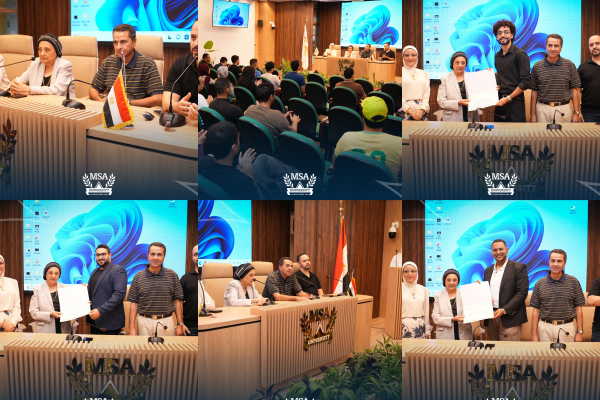
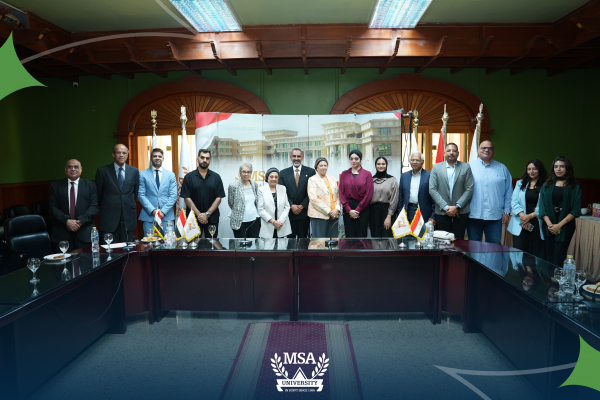
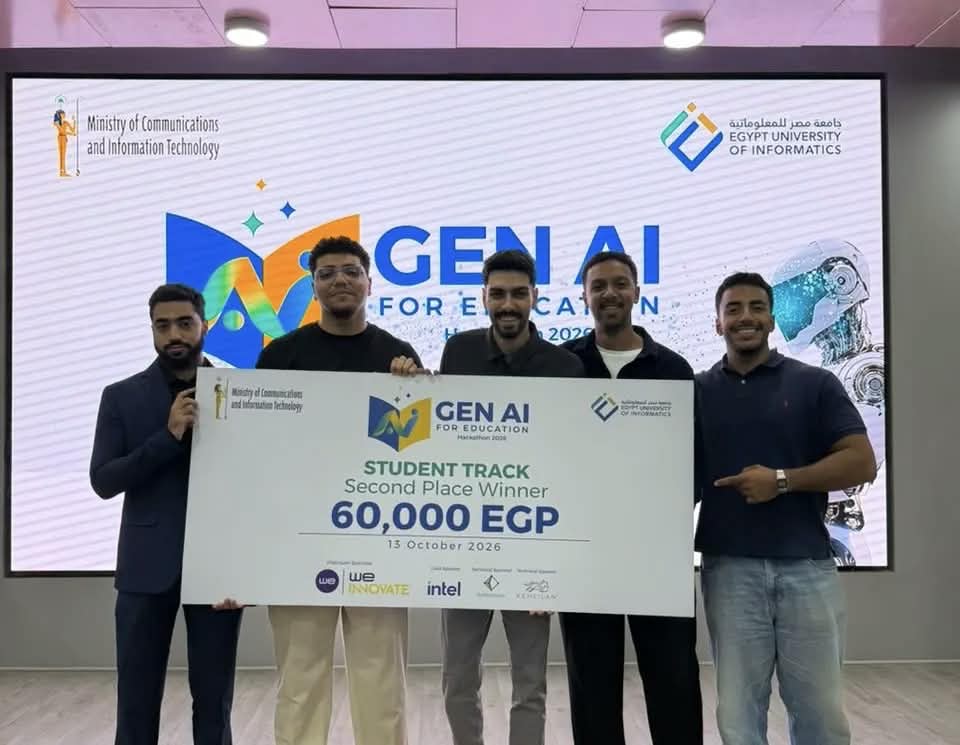
October University for Modern Sciences and Arts (MSA) proudly congratulates Mahmoud Balash, Ayman Negm, Emran Salah, Anas Abdullah, and Abdelrahman Salem, students of the Computer and Systems Engineering Department at the Faculty of Engineering, on securing second place in the Student Track of the Gen AI for Education Hackathon 2026, winning a prize of EGP 60,000 for their innovative project, Shafahi (شفهي).
The achievement came in a national competition that attracted significant participation, with 1,000 initial registrations, followed by 734 applicants representing 160 institutions and 228 team applications. Following the screening stage, 153 teams progressed, with 32 teams presenting their projects before the judging panel, and six winning teams ultimately receiving recognition across the competition’s two tracks.
Shafahi: Write the Code. Defend Your Thinking.
As generative AI continues to make it easier to produce working code, Shafahi addresses an important challenge in programming education: determining whether students truly understand the code they submit.
The project introduces an AI-powered oral assessment system in both Arabic and English. Students first write and test their own programming solutions, then explain their approach and respond to adaptive questions about their code. A Python execution sandbox checks the actual behaviour of the submitted program, helping the system identify gaps in students’ reasoning and guide further discussion.
Each assessment session generates a structured record of demonstrated understanding, providing students with targeted feedback, giving teachers insights into possible misconceptions, and offering parents an accessible view of students’ learning progress.
The Gen AI for Education Hackathon 2026 challenged students and startups to develop innovative solutions using generative AI to improve teaching, learning, assessment, and educational accessibility.
The initiative was organized with the support of Egypt University of Informatics (EUI) and the Ministry of Communications and Information Technology (MCIT), alongside WE INNOVATE as Platinum Sponsor, Intel as Gold Sponsor, and EdVentures and KEHEILAN as Technical Sponsors.
Following their success, the Shafahi team aims to pilot the project in real classrooms and evaluate whether students can retain programming concepts and independently explain the reasoning behind their solutions.
This achievement reflects the creativity, dedication, and innovative thinking of MSA Engineering students, while highlighting their ability to transform emerging technologies into practical solutions addressing real challenges in education.
MSA University proudly congratulates the Shafahi team on this distinguished achievement and looks forward to their next milestone.